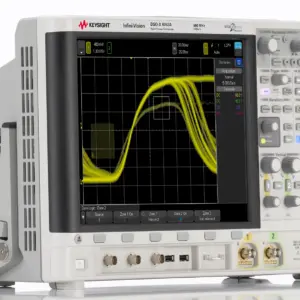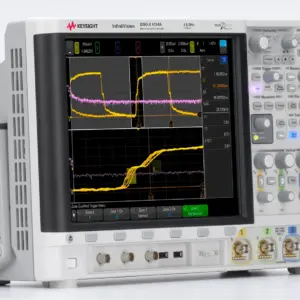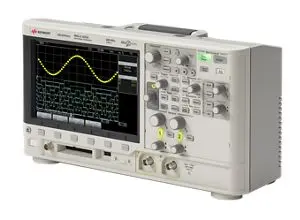

Description
Overview
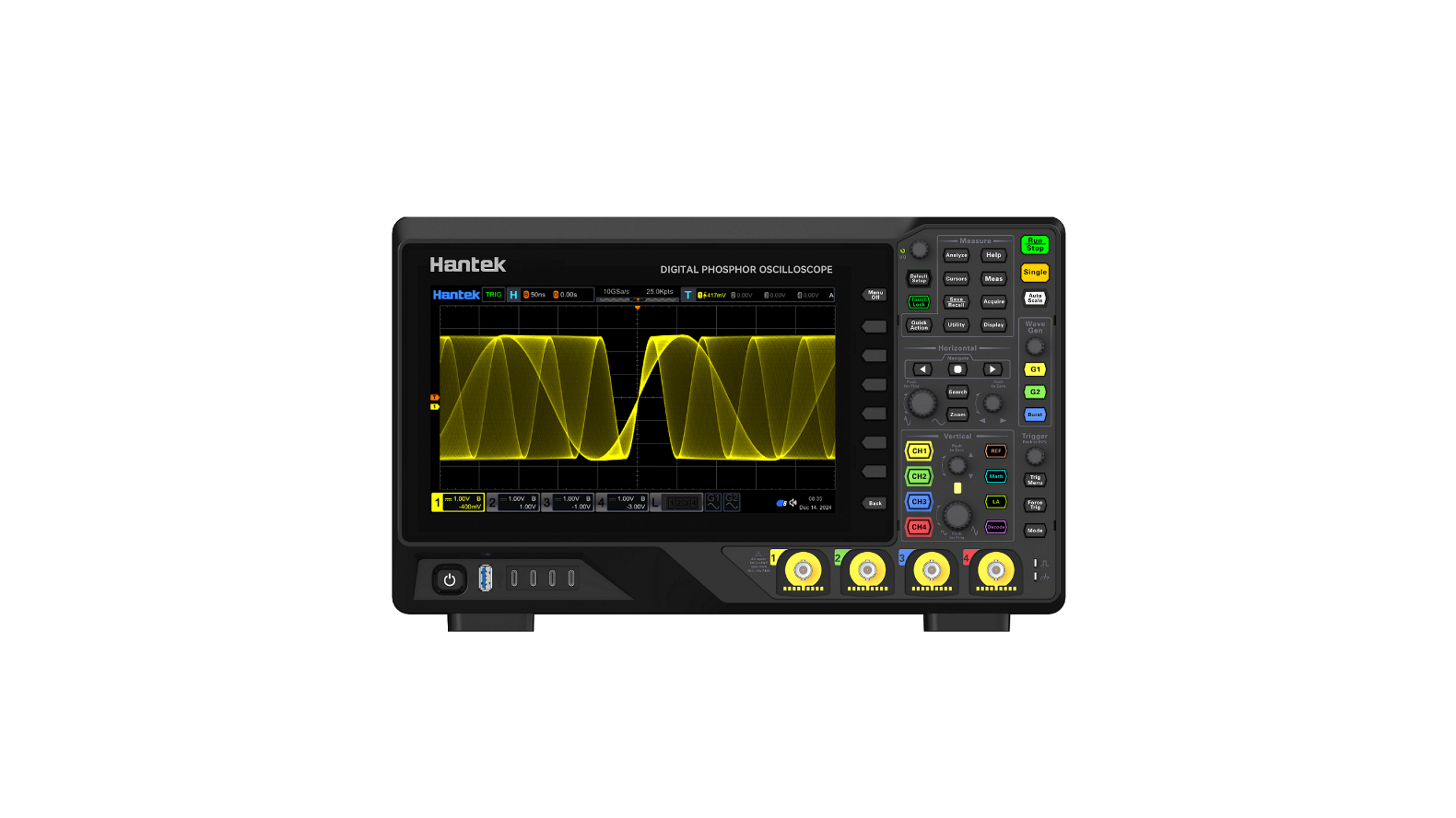
The Hantek HRDO4000 Series is built for engineers, R&D teams, test labs, production environments, and technical service professionals who need a modern oscilloscope platform with strong signal fidelity and multi-function integration. Official Hantek materials position the series around three core strengths: high resolution, high sampling performance, and rich built-in analysis capability. The series delivers 12-bit vertical resolution, supports up to 10 GSa/s real-time sampling, and reaches up to 3 GHz bandwidth on selected models, making it suitable for observing fine waveform details and faster edge behavior across a wide range of electronic systems.
What makes the HRDO4000 Series especially attractive for professional users is that it is not just a conventional oscilloscope. Hantek describes it as an 8-in-1 platform, combining multiple instruments into one chassis. Depending on the configuration, users can access a 4-channel oscilloscope, 16-channel logic analyzer, spectrum analyzer, 2-channel arbitrary waveform generator, digital voltmeter, frequency meter and accumulator, protocol analyzer, and protocol generator. This integrated approach can reduce bench clutter, simplify procurement, and improve workflow efficiency in environments where mixed-signal validation and debugging are routine.
The series is also designed to help users capture and interpret intermittent events more effectively. Hantek states that waveform capture rate is higher than 1.1 million waveforms per second, which supports faster discovery of abnormal or transient activity. In addition, the platform supports up to 51 automatic waveform measurements, hardware-based full-memory measurement, and analysis tools such as search, event list, histogram, baud chart, power analysis, and counter functions. For technical teams working on embedded systems, power electronics, communications, or board-level design, these built-in tools can reduce the time required to move from waveform capture to actionable insight.
The user interface also reflects this higher-end positioning. Official product information highlights a 10.1-inch multi-touch capacitive screen with 256-level waveform grayscale and color-temperature display, intended to improve visibility and ease of operation during long bench sessions. Combined with rich trigger and decode support for common serial buses, the series is clearly aimed at users who need both performance and usability in daily engineering work.
Key Features
The Hantek HRDO4000 Series is defined by several standout capabilities that make it suitable for demanding measurement tasks.
First, the series uses 12-bit vertical resolution, which can help reveal small signal changes and improve measurement confidence compared with lower-resolution instruments in suitable applications. Hantek pairs this with up to 10 GSa/s sampling and models reaching up to 3 GHz bandwidth, allowing the platform to address faster electronic signals and more detailed waveform analysis.
Second, selected HRDO4000 models offer expanded functionality beyond standard oscilloscope use. Hantek’s official comparison tables show variants with 16 logic channels and a built-in 2-channel 200 MHz waveform generator, while other variants omit one or both of those options. This makes the series flexible for customers who want a base oscilloscope or a more integrated mixed-signal test instrument.
Third, the built-in arbitrary waveform generator on supported versions is rated by Hantek at 2 channels, 200 MHz, ±7 V output, and 1 GSa/s, providing additional value for simulation, signal injection, and bench validation workflows. The official Chinese product page also lists a broad set of standard waveform types for the generator.
Fourth, the platform includes rich serial protocol triggering and decoding, with the official product information listing UART, I2C, SPI, LIN, and CAN decoding support. That makes the series suitable for embedded design verification, automotive electronics debugging, industrial control diagnostics, and general digital/analog mixed-signal troubleshooting.
Finally, the HRDO4000 Series includes a range of analysis and usability functions that help technical users work faster: search and navigation tools, event lists, histograms, power analysis, baud chart, counter functions, and large-screen touch interaction. These are exactly the kinds of content elements top-ranking product pages surface prominently, so they should also be featured clearly on your product page.
Applications
The Hantek HRDO4000 Series is suitable for a wide range of engineering and technical use cases. In embedded system development, it can help users verify clock behavior, decode serial communication, and troubleshoot intermittent digital faults. In power electronics and power supply design, the combination of high sampling performance and built-in power analysis tools can support switching waveform observation and efficiency-related testing. In communications and signal integrity work, higher-bandwidth models in the series can be used to observe faster signal edges and transient behavior more effectively. In manufacturing and quality assurance, integrated functions can reduce the need for multiple standalone instruments at the bench. And in technical service or failure analysis, the combination of oscilloscope, logic analysis, and generator capability can streamline root-cause investigation. These application areas are an informed fit based on the official feature set and built-in analysis functions described by Hantek.
Technical Specifications
Below is a specification table built only from official Hantek information. Because the HRDO4000 is a series, some values are series-level maximums and some depend on the chosen variant.
| Specification | Official Information |
|---|---|
| Product family | Hantek HRDO4000 Series digital oscilloscope |
| Analog channels | 4 channels on listed official comparison models |
| Bandwidth range | 500 MHz to 3 GHz, depending on model |
| Vertical resolution | 12-bit |
| Max real-time sampling rate | Up to 10 GSa/s |
| Max memory depth | 1 Gpts on official product table; manual appendix shows 2 Gpts in order information, so confirm exact model revision before publishing final specs |
| Max waveform capture rate | Higher than 1.1 million wfms/s |
| Logic analyzer | 16 channels on E-series variants |
| Built-in waveform generator | 2 channels, 200 MHz on E and D variants shown on official pages |
| AWG sampling rate | 1 GSa/s |
| AWG output voltage | ±7 V |
| Display | 10.1-inch multi-touch capacitive screen |
| Display enhancement | 256-level waveform grayscale and color temperature display |
| Auto measurements | Up to 51 waveform parameters |
| Serial decode | UART, I2C, SPI, LIN, CAN |
| Interfaces | Standard: USB Host, USB Device, LAN; Optional: HDMI, serial port |
| Input impedance | 1 MΩ and 50 Ω mentioned in manual/context |
| AC input power | 47–440 Hz, 90–264 VAC / 127–320 VDC, 80 W max |
| Certification | CE certification stated in manual |
The only spec area that needs special caution is memory depth. The official web product page lists 1 Gpts, while the manual appendix order-information screenshots show 2 Gpts for certain order entries. That likely reflects a revision difference or documentation mismatch, so do not hard-code one value on a live product page without confirming the exact SKU you sell.
Package Contents
Based on Hantek’s official product and manual materials, standard accessories include a USB cable, power cord conforming to destination-country standard, and oscilloscope probe(s). The official product page also references documentation such as calibration certificate, packing list, warranty card, and certificate of conformity. Probe model depends on the ordered version and bandwidth class, and Hantek also lists optional accessories such as a rack kit and logic analyzer accessories.
Call to Action
If your team is evaluating a high-performance mixed-signal oscilloscope platform for R&D, validation, production test, or advanced troubleshooting, the Hantek HRDO4000 Series offers a compelling combination of bandwidth, 12-bit resolution, integrated tools, and analysis features in one bench instrument. Contact us today to request pricing, confirm the correct HRDO4000 model for your application, and get support selecting the right bandwidth and option combination for your workflow.
【FAQ】
Q1: What is the Hantek HRDO4000 Series used for?
A: The Hantek HRDO4000 Series is designed for electronic signal measurement, waveform analysis, serial bus decoding, and mixed-signal debugging. Based on official Hantek information, it can be applied in R&D, embedded development, power analysis, and general laboratory test environments.
Q2: Is Hantek HRDO4000 a single model or a product series?
A: It is a product series. Official Hantek materials list multiple HRDO4000 variants with different bandwidths and option bundles, including versions with logic analyzer and waveform generator functions.
Q3: What are the main performance highlights of the HRDO4000 Series?
A: Official specifications highlight 12-bit vertical resolution, up to 10 GSa/s real-time sampling, up to 3 GHz bandwidth, and waveform capture rates above 1.1 million waveforms per second.
Q4: Does the HRDO4000 Series support serial bus decoding?
A: Yes. Hantek lists serial protocol triggering and decoding support, including UART, I2C, SPI, LIN, and CAN.
Q5: What accessories come with the HRDO4000 Series?
A: Official materials list standard accessories such as a USB cable, power cord, and oscilloscope probe(s). Some product-page materials also mention calibration-related documents and packing materials. Exact contents should be confirmed against the ordered model.