
Description
Overview
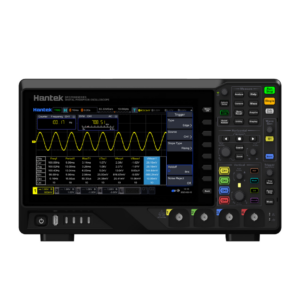
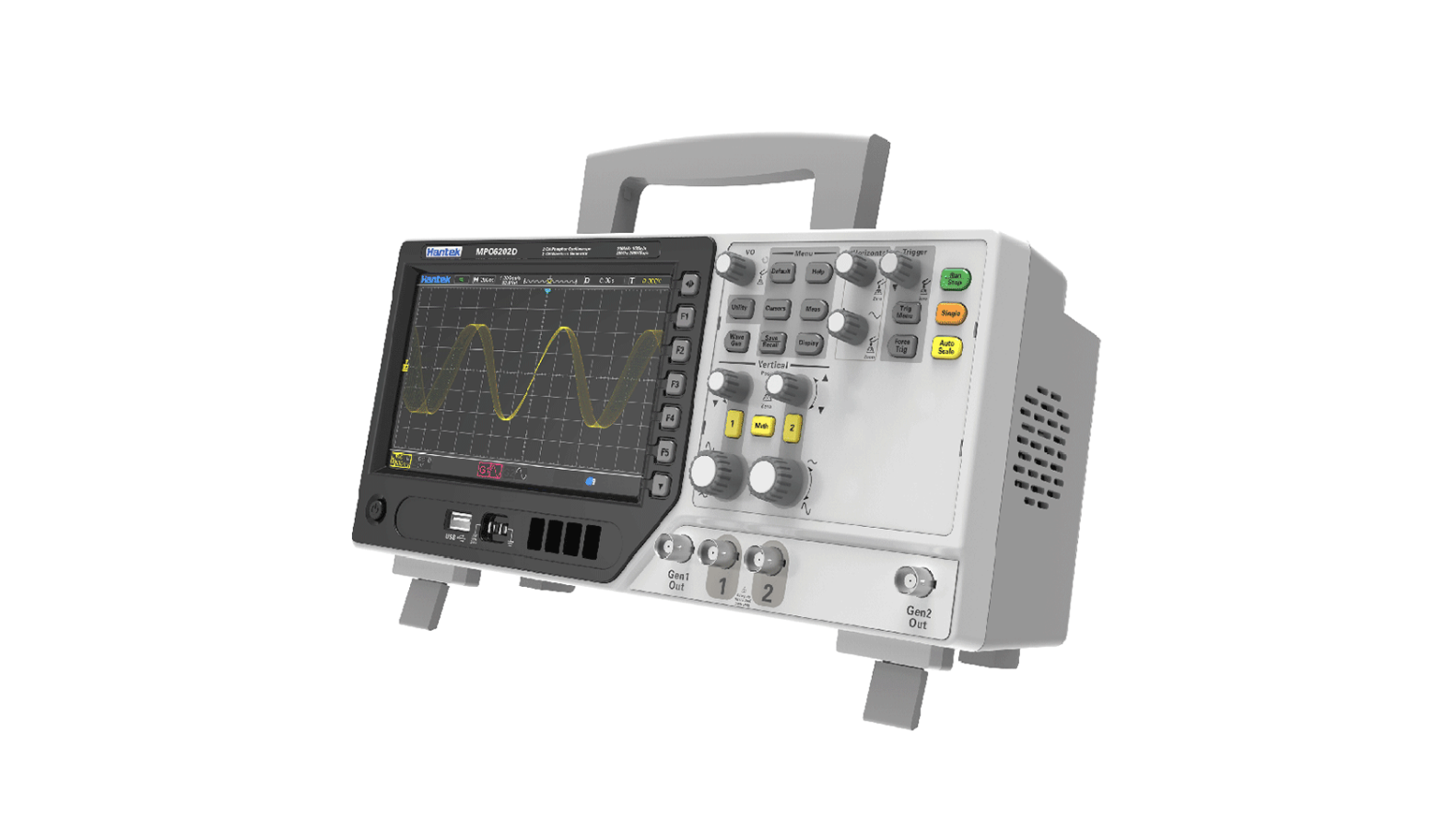
The Hantek DPO6000 series is built for users who need more than a basic bench oscilloscope. According to Hantek’s official product and manual materials, this family combines fast waveform capture, deep memory, wide dynamic range, and modern UI features into a compact bench instrument suitable for communication, aerospace, defense, embedded systems, computers, research, and education. The series is offered in multiple bandwidth levels, including 80 MHz, 100 MHz, and 200 MHz configurations, and it is designed around 4 analog channels with different model variants expanding functionality based on the application.
One of the most commercially important aspects of the DPO6000 family is its workflow efficiency. Hantek presents the platform as a multifunction test solution rather than only a waveform viewer. Official product pages highlight a “six in one” concept that can combine oscilloscope measurement, logic analysis, waveform generation, digital voltmeter capability, serial protocol analysis, and FFT spectrum-related functions, depending on the exact model. For engineering teams, this reduces bench clutter and may simplify procurement compared with buying multiple separate instruments for development, troubleshooting, and teaching labs.
Key Features
A major strength of the Hantek DPO6000 series is visibility into changing or intermittent signals. Hantek states that the series reaches 60,000 wfms/s in standard dots display and up to 400,000 wfms/s in quick acquisition mode, helping users capture abnormal or low-probability events more effectively. Combined with segmented acquisition supporting up to 80,000 sections, this makes the series useful for debugging burst activity, startup anomalies, communication events, and unstable embedded behavior.
Memory depth is another important decision factor, and the official product pages state 64 Mpts standard memory depth for the family. That gives users more acquisition time at meaningful sample rates and supports better visibility into long records without immediately sacrificing detail. Official Hantek parameter content also lists single-channel maximum record length at 64 M and indicates that memory allocation changes with active channel count.
The DPO6000 family is also designed to improve usability on the bench. Official sources describe a 7-inch WVGA capacitive touch screen with 800 × 480 resolution, multi-touch support in the manual, and vivid TFT display characteristics. Hantek also highlights 256-grade intensity display, color temperature display, adjustable brightness, and a wide vertical scale range from 500 μV/div to 10 V/div, which helps when moving between low-level analog signals and higher-amplitude measurements in practical test environments.
Triggering and protocol support are central selling points. Hantek states up to 16 trigger functions and 5 protocol-trigger/serial decoding options. This is valuable for users working with embedded systems, board bring-up, serial buses, and event-driven troubleshooting. The official product messaging also highlights event search, automatic measurement of 42 waveform parameters with statistics, and math operations including FFT, differential, integral, and square-root functions.
Depending on the variant, the DPO6000 platform can also include a built-in 2-channel waveform generator. Official Hantek parameter listings specify 200 MSa/s generator sample rate, 12-bit vertical resolution, maximum 25 MHz output frequency, 13 standard waveforms, 4 arbitrary waveform memories, 8 KSa waveform length, and 50 Ω output impedance. MPO variants additionally include 16 digital channels, with official threshold options covering TTL, several CMOS levels, ECL, PECL, LVDS, 0 V, and user-defined settings.
Applications
The official Hantek materials explicitly position the DPO6000 family for communication, aerospace, defense, embedded systems, computers, research, and education. In practice, that means the series is suitable for board-level debugging, power rail observation, serial-bus decoding, functional verification, service diagnostics, student laboratories, and general-purpose R&D validation. Teams evaluating mid-range bench oscilloscopes will likely see the most value when they need a combination of deep memory, multiple analog channels, optional mixed-signal capability, and practical built-in tools on one platform.
For procurement teams, the family structure is also important. Official model listings show that different DPO6000 and MPO6000 variants map to different bandwidth and feature combinations. That makes the series suitable for organizations standardizing on one interface and accessory ecosystem while still matching instrument cost to lab task complexity. If your site sells a specific unit rather than the family, the final page should swap the generic “DPO6000 series” language below with the exact SKU name and only the specs that apply to that SKU.
Technical Specifications
| Specification | Officially Verified Information |
|---|---|
| Product family | Hantek DPO6000 / MPO6000 series digital phosphor oscilloscope family |
| Analog channels | 4 analog channels |
| Digital channels | MPO6000 series includes 16 digital channels; DPO6000 can add digital capability with LP104 digital probe per manual |
| Bandwidth options | 80 MHz, 100 MHz, 200 MHz family options |
| Real-time sample rate | 1 GSa/s analog channels; 1 GSa/s digital channels |
| Memory depth | 64 Mpts standard memory depth for the family |
| Capture rate | 60,000 wfms/s standard dots display; up to 400,000 wfms/s quick acquisition mode |
| Segmented acquisition | Up to 80,000 sections |
| Display | 7-inch WVGA TFT touch display, 800 × 480 |
| Intensity grading | 256-grade intensity / color-temperature display |
| Vertical resolution | 8-bit analog, 1-bit digital |
| Vertical scale range | 500 μV/div to 10 V/div |
| Input impedance | Analog: 1 MΩ ±2%, 25 pF ±3 pF; Digital: 300 kΩ ±2%, 8 pF ±3 pF |
| Input coupling | DC, AC, or GND for analog channels |
| Trigger functions | Up to 16 trigger types, including protocol triggers |
| Serial decode | 5 serial decoding options |
| Auto measurements | 42 waveform parameters with statistics |
| Generator (variant-specific) | 2-channel generator on supported variants; 25 MHz max, 200 MSa/s, 12-bit, 8 KSa, 13 standard waveforms + 4 arbitrary |
| Interfaces | USB Host, USB Device, LAN; some optional/education interfaces also listed in official parameters |
| Safety / input class | 300 V CAT II; analog max input 300 VRMS (10X) |
Package Contents
Typical package contents should be confirmed against the exact SKU and seller bundle before publishing. Official documentation indicates DPO6000 series units are equipped with passive probes as standard, while MPO6000 series units include passive and digital probes as standard. On a sales page, list only the accessories actually included in your warehouse bundle, such as the oscilloscope main unit, passive probes, power cable, USB cable, quick guide, and any applicable digital probe or waveform-generator-enabled configuration.
Call to Action
Choose the Hantek DPO6000 series when your team needs a practical, feature-rich bench oscilloscope platform that balances waveform visibility, memory depth, mixed-signal expandability, and day-to-day usability. Contact us for the correct DPO6000-series configuration, current availability, accessory options, and a quotation matched to your lab, service bench, or production debug workflow.
【FAQ】
Q1: What is the bandwidth range of the Hantek DPO6000 series?
A1: Official Hantek sources list the DPO6000 family in 80 MHz, 100 MHz, and 200 MHz bandwidth options, depending on the exact model.
Q2: Does every Hantek DPO6000 model include a waveform generator and logic analyzer?
A2: No. The series includes different variants. Official Hantek listings show some models with a built-in 2-channel waveform generator, while MPO models add 16 logic channels. The exact configuration depends on the SKU.
Q3: What is the maximum sample rate of the Hantek DPO6000 series?
A3: Hantek officially states 1 GSa/s real-time sample rate for analog channels and 1 GSa/s for digital channels.
Q4: How much memory depth does the Hantek DPO6000 series provide?
A4: Official product pages state 64 Mpts standard memory depth for the family, which helps capture longer records while preserving detail.
Q5: What kinds of users is the Hantek DPO6000 series designed for?
A5: Hantek positions the series for communication, aerospace, defense, embedded systems, computers, research, and education applications.