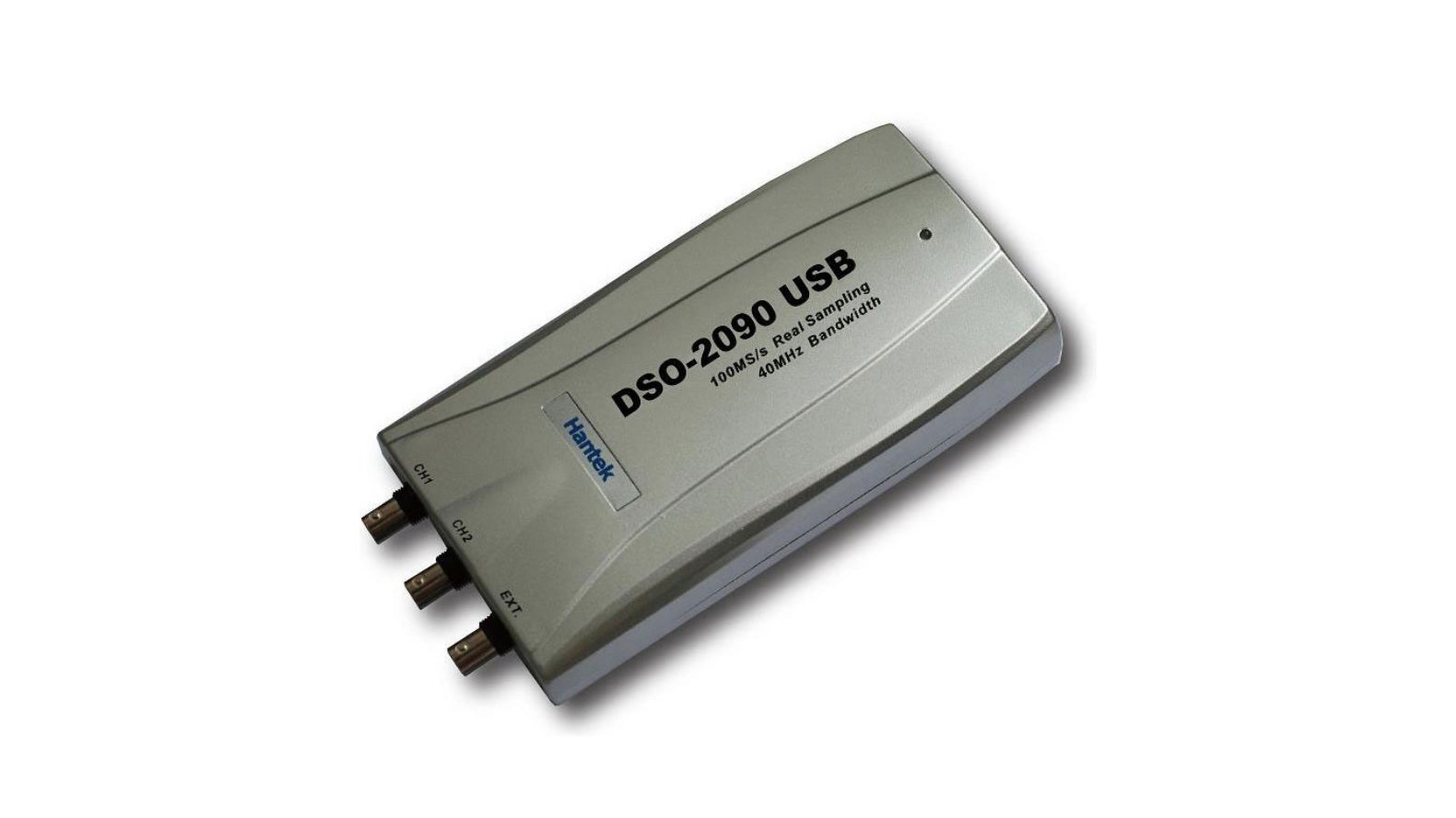

Description
Overview
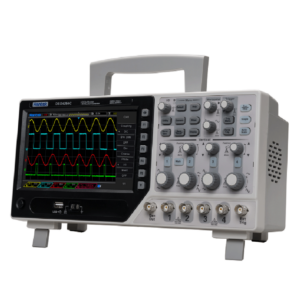
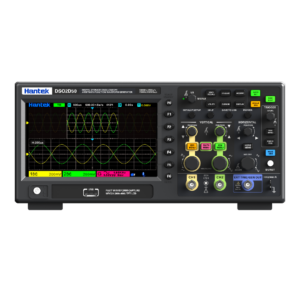
The Hantek DSO2000 Series is a bench digital storage oscilloscope family developed for users who need practical measurement capability without moving into a much higher price tier. According to Hantek’s current product information, the series includes DSO2C10, DSO2C15, DSO2D10, and DSO2D15. All models provide 2 analog channels, a 7-inch TFT display, up to 1 GSa/s sampling on a single channel, and 8 Mpts maximum memory depth, which helps preserve waveform detail during longer captures and deeper analysis.
What makes the DSO2000 Series especially relevant for engineers and technical buyers is the balance between standard oscilloscope functions and added debugging tools. Hantek lists 14 trigger types, serial bus trigger and decode, math functions including FFT, 32 automatic measurements with statistical analysis, and SCPI remote-control support. The DSO2D variants also add a 1-channel 25 MHz waveform generator, making them more versatile for development benches that need both signal observation and basic stimulus generation in one instrument.
This product family is suitable for electronics labs, embedded system testing, repair environments, educational setups, and general-purpose debugging. Hantek also positions the series for communication, aerospace, embedded systems, computing, research, and education applications. While that is broad positioning from the manufacturer, the underlying feature set does support common daily use cases such as power-supply inspection, sensor output verification, serial interface debugging, waveform comparison, and production-line troubleshooting.
Key Features
1. Two-channel architecture for practical mixed-signal-style debugging
Each DSO2000 model provides 2 analog channels, allowing users to compare input and output waveforms, monitor clock and data relationships, or inspect multiple analog points during circuit bring-up. Independent controls improve workflow efficiency during bench work.
2. Up to 150 MHz bandwidth and 1 GSa/s sampling
The family is split between 100 MHz and 150 MHz variants. Sample rate is specified as 1 GSa/s on single-channel operation and 500 MSa/s on dual-channel operation, helping maintain usable timing resolution in common test scenarios.
3. 8 Mpts memory depth for longer captures
A maximum 8 Mpts record length supports deeper acquisition and reduced waveform loss when observing long or bursty signals. This is useful for intermittent events, serial analysis, and troubleshooting faults that do not appear in very short acquisition windows.
4. Serial trigger and decode support
Hantek lists serial trigger/decoding for RS232/UART, I2C, SPI, CAN, and LIN, which is valuable for embedded development, automotive electronics, and board-level diagnostics. This feature helps technical teams move beyond analog-only viewing and into protocol-aware debugging.
5. 14 trigger modes and 32 automatic measurements
The series supports trigger types such as Edge, Pulse Width, Video, Slope, Overtime, Window, Pattern, Interval, Under Amp, UART, LIN, CAN, SPI, and IIC, as well as 32 automatic measurements with statistics including minimum, maximum, and standard deviation. That combination improves repeatability for engineering evaluation and fault analysis.
6. Built-in waveform generator on DSO2D models
The DSO2D10 and DSO2D15 include a 1-channel 25 MHz waveform generator. Hantek specifies standard waveforms such as sine, square, pulse, triangle, sample, exponential, and noise, plus several arbitrary waveform slots. This is particularly useful for design validation and lab setups where separate signal generation is not always convenient.
7. DVM, frequency counter, USB connectivity, and SCPI control
The DSO2000 Series includes digital voltmeter functions, a hardware frequency indicator, USB Host/Device, and SCPI remote commands. These features make the instruments easier to integrate into test benches, reporting workflows, and PC-assisted measurement tasks.
Applications
The Hantek DSO2000 Series is well suited for a wide range of technical environments. In embedded system development, it can be used to inspect clock lines, UART traffic, sensor outputs, and power rails. In industrial maintenance and repair, it helps technicians quickly isolate unstable analog signals, missing pulses, or communication problems across control boards. In education and lab training, it offers a broad enough feature set to support waveform fundamentals, trigger concepts, FFT demonstrations, and serial bus exercises. In procurement-driven environments, the DSO2000 family can also be attractive where teams want a bench oscilloscope with modern decoding and waveform storage features but without stepping into a premium price class. These use cases are aligned with Hantek’s own positioning for communication, embedded systems, computers, research, and education.
Technical Specifications
| Specification | Verified Details |
|---|---|
| Series Models | DSO2C10, DSO2C15, DSO2D10, DSO2D15 |
| Channels | 2 analog channels |
| Bandwidth | 100 MHz or 150 MHz depending on model |
| Sample Rate | 1 GSa/s single channel, 500 MSa/s dual channel |
| Memory Depth | Up to 8 Mpts |
| Vertical Resolution | 8-bit |
| Vertical Sensitivity | 2 mV/div to 10 V/div |
| Input Impedance | 1 MΩ ±2% |
| Max Input Voltage | 300 VRMS (10X), 300 V CAT II |
| Display | 7-inch TFT LCD, 800 × 480 |
| Trigger Types | 14 types including Edge, Pulse Width, Video, Slope, Window, UART, LIN, CAN, SPI, IIC |
| Serial Decode | RS232/UART, I2C, SPI, CAN, LIN |
| Automatic Measurements | 32 types with statistics |
| Math Functions | +, -, ×, ÷, FFT |
| Interfaces | USB Host, USB Device |
| DVM / Counter | Digital voltmeter and hardware frequency indicator |
| Waveform Generator | 1CH 25 MHz on DSO2D10 / DSO2D15 only |
| Power | 100–240 VAC depending on range / frequency conditions listed by Hantek |
| Dimensions | 318 × 110 × 150 mm |
| Weight | 1900 g |
Source basis: Hantek official English and Chinese product pages.
Package Contents
Please verify the exact box contents with your supplier before publishing a final commercial listing, because the official pages show the series accessories section but do not expose a clean, single universal package list in the search snippet. A safe website version is:
Typical package contents may include the main oscilloscope unit, matching passive probes, power cord, user documentation, and standard accessories supplied by Hantek for the selected model. Confirm the exact accessory set for DSO2C vs DSO2D variants before shipment or quotation.
Call to Action
Looking for a practical oscilloscope for design verification, troubleshooting, maintenance, or technical training? The Hantek DSO2000 Series combines essential bench performance with protocol decoding, statistical measurements, USB connectivity, and optional waveform generation in selected models. Contact us for model selection support, quotation, and availability for DSO2C10, DSO2C15, DSO2D10, or DSO2D15.
【FAQ】
Q1: What models are included in the Hantek DSO2000 Series?
A1: The current Hantek DSO2000 bench series includes DSO2C10, DSO2C15, DSO2D10, and DSO2D15.
Q2: Does the Hantek DSO2000 Series support serial bus decoding?
A2: Yes. Hantek lists serial trigger and decode support for RS232/UART, I2C, SPI, CAN, and LIN.
Q3: Which Hantek DSO2000 models include a waveform generator?
A3: The DSO2D10 and DSO2D15 include a built-in 1-channel 25 MHz waveform generator. The DSO2C10 and DSO2C15 do not.
Q4: What is the maximum sampling rate of the Hantek DSO2000 Series?
A4: Hantek specifies up to 1 GSa/s in single-channel mode and 500 MSa/s in dual-channel mode.
Q5: Is the Hantek DSO2000 Series suitable for embedded debugging?
A5: Yes. Its combination of 2 analog channels, serial protocol decoding, automatic measurements, FFT, and optional waveform generation makes it suitable for many embedded development and troubleshooting tasks. This is an evidence-based use-case inference from the official feature set, not an additional manufacturer specification.